
Most leadership content is written by people who've never been on shift.
This isn't that.
Practical frameworks and perspectives on leadership in veterinary medicine — written from inside the hospital, for people still in it.
How to Build a Veterinary Mentorship System (When You Don't Have a Corporate Program Behind You)
Your new graduate is eleven weeks in. She has done her first solo spay, run her first euthanasia conversation alone, and turned down a workup she did not think was indicated. None of it was discussed afterward, and she is filing every judgment as correct because nobody told her otherwise. Mentorship is the only commitment in a veterinary hospital with no protected time and no owner.
What Veterinary Hospital Management Actually Requires
Most veterinary hospitals have two leaders and a well-defined split between them. Almost nothing formally owns the space in between. That seam is where the recurring problems live, and no software module will close it.

You Don't Own the Building: Leading Clinically Inside Corporate Structures
You don't own the building. About 75% of ER and specialty hospitals run on someone else's incentives, and the medical director sits on the fault line between what corporate measures and what the floor needs. Here's the three-mode system that keeps both your clinical integrity and your job.
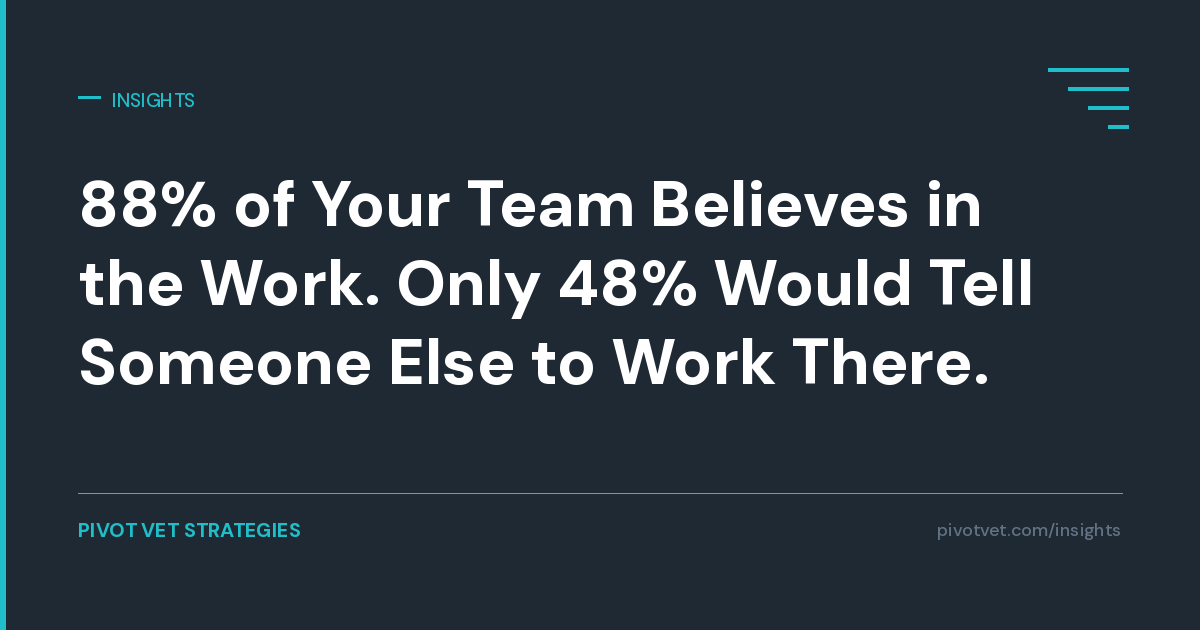
88% of Your Team Believes in the Work. Only 48% Would Tell Someone Else to Work There.
88% of veterinary team members believe in their hospital's mission. Only 48% would recommend their practice as a great place to work. The 40-point gap between those numbers is not a morale problem. It is a leadership environment problem — and it is the most quantified version of the case for building one.
Twelve Signs Your Hospital Has a Leadership Gap
A leadership gap rarely arrives as a crisis. It accumulates as repetition — the same conflict every few months, the best people leaving without explanation, the hospital running differently when one person is off. Twelve specific signs, read against your own floor, and what the pattern is actually costing you.
Veterinary Medicine Doesn't Have a Burnout Problem. It Has a Leadership Infrastructure Problem.
A veterinary hospital can offer every wellness resource available and still have a burnout problem six months later. Most burnout interventions treat the clinician as the variable — when the variable is the environment around them. Burnout is not primarily a failure of individual capacity. It is a failure of leadership infrastructure.
Psychological Safety Is Not Built by Invitation. It Is Built by Pattern.
Veterinary leaders believe their team feels safe to speak up because they've extended the invitation. The team's behavior suggests something different. Psychological safety is not built by offering it — it is built by what the team has learned to expect the last time someone actually did.
What Veterinary Staff Turnover Actually Costs (With the Math)
Leadership failure rarely announces itself. It shows up as a pattern, months before it shows up as a departure, and it costs far more than most hospitals have ever calculated.
Accountability Isn’t Cruelty in Veterinary Medicine. Avoiding It Is.
Avoiding accountability doesn’t protect your team. It redistributes the cost of the problem onto the people least responsible for it. Here’s what accountability actually looks like as a system — not a personality trait.
High Performance Is Not Enough: When Your Strongest Clinician Becomes a System Risk
A high-performing clinician who operates outside expected behavior — and goes uncorrected — is not just an interpersonal problem. They are a system risk. Here's what that looks like from the inside, and what leadership has to do about it.
Clinical Excellence Is Not a Leadership Qualification. Veterinary Medicine Has Been Using It as One.
Veterinary medicine selects its leaders by clinical performance and provides them almost no structural preparation for what leadership actually requires. The gap between those two things is not a training problem. It is an architecture problem.
Reading about it
is step one.
Building it is the work.
TRIAGE™ is where the concepts in these articles become an operating system your team can actually run on.